The music and images are for expanding your musical taste into the greatest musical experience in our generation. There will Never be another time when music expressed so much for so many. If you like an album, support the artist and go buy it IF you can find it. Look for great used record stores in your area. I will post music that may be very hard to find (if not impossible) I will post music I find on the internet to promote sharing the music to others around the world. I do Not receive any monetary gain in what I place on this site. I am here to share and do appreciate what others have to share with me. Files are in mp3 format and the sound quality is much much better from a CD so once again if you can find it please purchase it.
If you are an artist or copyright owner of anything posted and object to the material in question please email me and I will remove the violating item, Please do me a favor and just contact me and I will take care of the situation. Music was meant to be heard and enjoyed by all that are grateful.
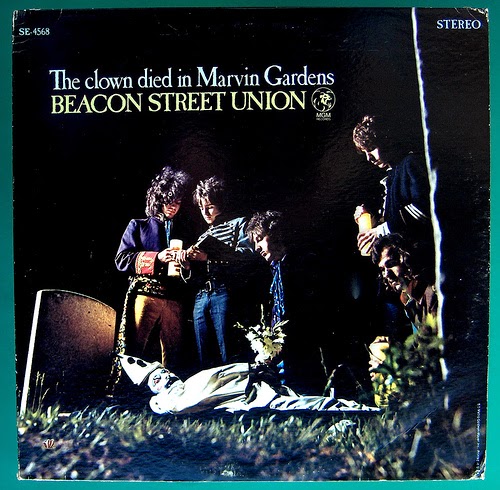
The Beacon Street Union was a 1960s psychedelic era rock band, named for a street in their native Boston, whose original members were John Lincoln Wright (vocals, percussion), Paul Tartachny (guitar, vocals), Wayne Ulaky (bass, vocals), Robert Rhodes (keyboards, bass), and Richard Weisberg (drums). With the exception of a few rock standards, their diverse music was composed by group members, primarily Wright and Ulaky. A later lead singer was Travis Fields.
MGM Records promoted them as part of the so-called "Bosstown Sound" (along with the groups Ultimate Spinach and Orpheus), with little success. Their first album was released directly before Ultimate Spinach's first album. After two albums, Wright, Ulaky, and Rhodes were joined by guitarist Jamie James and recorded an album as Eagle.
The Beacon Street Union were part of the dreaded, overhyped Bosstown Sound. The scene was a reaction to the San Fransisco rock explosion but Bosstown could in no way compete with the Bay area. The Beacon Street Union released three good experimental psych/hard rock albums (one album under the Eagle moniker) during the late 60’s and early 70’s. They were one of the best among a desperate bunch which included the Ultimate Spinach, Eden’s Children, Puff and Orpheus.
Eyes Of The Beacon Street Union
Recitation
My Love Is
Beautiful Delilah
Sportin' Life
Four Hundred And Five
Mystic Morning
Sadie Said No
Speed Kills
Blue Avenue
South End Incident
Green Destroys The Gold
The Prophet
The Clown Died In Marvin Gardins
Blue Suede Shoes
Not Very August Afternoon
May I Light Your Cigarette
The Clown Died in Marvin Gardens
Angus of Aberdeen
King of the Jungle
The Clown's Overture
Now I Taste the Tears
Baby, Please Don't Go
Sunday, September 23, 2012
The Velvet Underground: Psychedelic Sounds From The Gymnasium.
Recorded Live at The Gymnasium, New York City, New York, USA - April 30, 1967.
Soundboard Recording
01. Im Not A Young Man Anymore
02. Guess Im Falling In Love
03. Im Waiting For The Man
04. Run Run Run
05. Sister Ray
06. BookerT
Total Time: 00:49:26
Personnel: Lou Reed :: John Cale :: Sterling Morrison :: Maureen Tucker :: Nico.
Ultimate Spinach was a psychedelic/hard rock/blues band originally from Boston. In their '60's heyday they specialized in lengthy songs such as "Ballad of the Hip Death Goddess", from Ultimate Spinach (1968) and "Genesis of Beauty", from Behold And See (1968).
ULTIMATE SPINACH
"Mind Flowers"
Live at the Unicorn Coffee House
Boston, MA, July 1967
Track list:
01. Hey Joe (4:14)
02. Get Together (4:11)
03. I Don't Know You (3:48)
04. Funny Freak Parade / Don't Let These Years Go By (6:07)
05. Don't Cry For Me (3:51)
06. Follow Me (4:37)
07. Ballad Of The Hip Death Goddess (6:19)
08. Mind Flowers (12:46)
Line-up:
Ian Bruce Douglas: vocal, electric piano, 12-string guitar
Barbara Hudson: vocals, electric guiar, kazoo
Keith Latheinen: vocal, drums
Richard Nese: bass
Geoffrey Winthorp: vocal, lead guitar, sitar, electric sitar
The Blues Magoos are a rock music group from the The Bronx, New York. They were at the forefront of the psychedelic music trend, beginning as early as 1966.
The band was formed in 1964 as "The Trenchcoats". The original members were Emil "Peppy" Thielhelm aka "Peppy" Castro (vocals and guitar), Dennis LePore (lead guitar), Ralph Scala (organ and vocals), Ron Gilbert (bass) and Jon Finnegan (drums). The band made a name for itself in various clubs in Greenwich Village. By 1966 the band had changed its name to fit in with the psychedelic vibe of the times - they first changed their name to the Bloos Magoos, though they changed that to the more conventional Blues Magoos. They also made some line-up changes, bringing in Mike Esposito as lead guitarist, and Geoff Daking as drummer.
Like their name, the group's sound was of the psychedelic variety. They released the "So I'm Wrong and You Are Right" b/w "The People Had No Faces" single on Verve Records, but did not gain the band much recognition. However, Mercury Records signed the band to a record deal in late 1966 and the group's debut album, Psychedelic Lollipop was released shortly thereafter. It was one of the first records to contain the word "Psychedelic" on the sleeve (along with the 13th Floor Elevators' first album, The Psychedelic Sounds of the 13th Floor Elevators, and The Deep's Psychedelic Moods, both also from 1966). They played a lot then at the Chess Mate Coffeehouse owned by Morrie Widenbaum, a mostly folk venue that also hosted bands like Southbound Freeway, Siegel-Schwall Blues Band and Blues Magoos.
In a tour of the US in 1967 they were the opening act followed by The Who and then the headliners Herman's Hermits. The group's biggest song, "(We Ain't Got) Nothin' Yet", whose Vox Continental organ riff bears an uncanny resemblance to the 1962 hit by Ricky Nelson, "Summertime" (Deep Purple also used this riff in their hit "Black Night"), was released as a single in 1967 (albeit from their 1966 album), with "Gotta Get Away" as the b-side. The song hit number 5 on the US charts, although it did not fare nearly as well in the UK. It was used for the movie Easy Rider in 1968.
The next single by the Blues Magoos, "There's A Chance We Can Make It," was only a minor hit, with its b-side "Pipe Dream" actually charting higher (though neither side hit the top 40). After one more minor chart single with "One By One," subsequent singles were largely ignored by record buyers. Neither of the two albums released after Psychedelic Lollipop, Electric Comic Book and Basic Blues Magoos, had much success. By 1968, the band was discouraged and they split up.
The group's management had other plans. The band was signed to ABC Records, but most of the members did not go along with this plan. Only Castro agreed and started up a revamped Blues Magoos, with Eric Kaz, Richie Dickon, John Leillo and Roger Eaton. The other Blues Magoos moved to the west coast, enlisted Ted Munda, and released the "Let Your Love Ride" b/w "Who Do You Love" single on Ganim Records in 1969 before replacing Munda with Joey Stec, formerly of The Millenium, and then eventually going their separate ways. Ralph Scala and Joey Stec later resurfaced as members of The Dependables. In 1969, the Castro-led band completed Never Goin' Back To Georgia, but that release did not attract public attention either. Eaton left the band, and the other Blues Magoos used session musicians for the follow-up Gulf Coast Bound. It did poorly as well and though the Magoos struggled for another two years, they eventually parted ways.
After a stint with the rock musical Hair and recording with Mercury label mate Exuma (Tony McKay), Peppy Castro formed Barnaby Bye with fellow cast members Bobby and Billy Alessi.The group released two albums on Atlantic records, "Room to Grow" (1972) and "Touch" (1973).] In 1981, Castro resurfaced again with the group Balance whose song "Breaking Away" reached No. 22 on the Billboard Hot 100 chart. In July 2008, the Blues Magoos with original members Ralph Scala, Castro and Geoff Daking reunited for the first time in years for two concerts, including one with The Zombies at the Fillmore New York at Irving Plaza in New York City. In December 2009 they traveled to Spain for the Purple Weekend festival.
In 2012, The Blues Magoos will release their first new album in 41 years, titled Psychedelic Resurrection. Along with this, will come a Nationwide tour.
Blues Magoos
Cavestomp
New York, NY
11-3-2000
01 Tuning /Rush Hour
02 Pipe Dream
03 There's a Chance We Can Make It
04 I Wanna Be There
05 Albert Common Is Dead
06 Sometimes I Think About
07 One By One
08 Life Is Just A Cher O'Bowlies
09 Love Seems Doomed
10 Gotta Get away
11 There She Goes
12 (We Ain't Got) Nothin'Yet
13 Tobacco Road
Ralph Scala, keyboards and vocals Emil "Peppy" Thielheim, guitar & vocals Mike Esposito, guitar & theremin Geoffrey Daking, drums Peter Stuart, bass & vocals Dean Scala, guitar & vocals Beki Brindle, guitar & vocals
The band was formed in Jacksonville, Florida on March 26, 1969, and consisted of Duane and Gregg Allman, Dickey Betts, Berry Oakley, Butch Trucks, and Jai Johanny Johanson. Brothers Duane and Gregg Allman grew up in Daytona Beach, Florida, and had been playing music publicly since the early 1960s. They formed a garage band called the Escorts in 1963, which evolved into the Allman Joys in 1965.From there the brothers formed The Hour Glass and moved to Los Angeles. The Hour Glass released two failed albums on Liberty Records in 1967 and 1968. They were all released from the contract except Gregg, who Liberty thought might have some commercial potential.] Gregg and Duane had previously met Butch Trucks and his band The 31st of February while touring as the Allman Joys, and decided to record an album with them in September 1968, shortly after the breakup of The Hour Glass. This album was eventually released as Duane & Greg Allman on the Bold Records label in 1972. Duane Allman played on Wilson Pickett's hit version of "Hey Jude" and became the primary session guitarist for FAME Studios in Muscle Shoals, Alabama, recording with Aretha Franklin, King Curtis, Percy Sledge, and others. Allman started jamming with Dickey Betts, Butch Trucks and Berry Oakley in Jacksonville. Eddie Hinton, with whom Duane Allman had played in Muscle Shoals, was considered to play guitar, but Hinton refused in order to join the Muscle Shoals studio band. Duane brought in Jaimoe, a drummer he had played with in the past. Gregg was in Los Angeles, fulfilling the Hour Glass contract with Liberty Records. He was summoned back to Jacksonville.
The Blues Magoos from the Bronx were one of the really first psychedelic bands of the mid sixties. Their first three LP's were along that vain of music and presentation. Then it all went south. The original band dissolved but the band's management got Peppy(the only original member) a contract at ABC records. The LP that followed was truly not the same band. Peppy took the sound to a Latin-Jazz-Blues based type of music. They made two LP's in this format and then again dissolved. OMO is that it is not a bad sound at all but maybe would have been a little more accepted if it had not been under the Blues Magoo's moniker.
The Fudge ...very strange in their own way. They seemed to have a really different approach to the music they played. They mostly took other people's music( and they seemed to like the Supremes} and re- structured it to their own format. Unique in it's approach, this one does give us some original material by the band.Tim Bogert and Carmine Appice both went on to successful careers with Cactus , Jeff Beck and more.But for some strange reason always returned to their Vanilla Fudge beginnings. I believe this was their last original LP before embarking on the nostalgia trail . In 2007 they did make a tribute LP to Led Zeppelin (once again covering other's material) One word covers their career.... MYSTERY
Fred Neil (March 16, 1936 – July 7, 2001) was an American blues and folk singer and songwriter, whose career developed in the 1960s and early 1970s, getting away from the music scene since then until he died. Best remembered for writing hits like "Candy Man" by Roy Orbison and "Everybody's Talkin'" by Harry Nilsson, as well as the ballad "A Little Bit Of Rain", and the rock standard "The Other Side of This Life", most famously covered by Jefferson Airplane.
Born in Cleveland, Ohio, but raised in St. Petersburg, Florida, Neil was one of the singer-songwriters who for a time worked out of New York City's famous Brill Building. He has often been called a pioneer of the Folk rock & Singer-songwriter musical genres; his most frequently cited disciples are Karen Dalton, Tim Hardin, Dino Valenti, Vince Martin, Peter Stampfel -of the avant-folk ensemble The Holy Modal Rounders-, John Sebastian -The Lovin' Spoonful, Jerry Jeff Walker, and Paul Kantner -Jefferson Airplane-, but maybe his most prominent descendants have been Tim Buckley, Stephen Stills, David Crosby and Joni Mitchell. Some of Neil's early compositions were recorded by Buddy Holly and Roy Orbison; he played as a session guitarist on "Dream Lover," the 1958-hit by Bobby Darin, and he even became demo singer for an Elvis movie soundtrack session at the end of the 50's. By then, Neil recorded six singles for different labels, mostly rockabilly-pop oriented, at the time he keep on composing at the Brill Building for other artists. Although it wasn't until 1968, when Nilsson recorded a cover version of Neil's song "Everybody's Talkin'," which became a huge hit a year later when it was featured in the film Midnight Cowboy.
According to Anthony DeCurtis' Rolling Stone obit on Fred, "...So why is Neil a hero to David Crosby? Because back when Crosby was an aspiring folkie who just arrived in New York, Neil bothered to take an interest in him, just as he did for the young Bob Dylan, who backed Neil on harmonica at the Cafe Wha? in Greenwich Village. "He taught me that everything was music," Crosby says...."
Richie Havens, in his memoir, recounts Fred Neil and then-partner Vince Martin's ability to get the audience up and clapping with an entry through the audience, sans microphones, relying only on their harmonious vocals.
Neil was an accomplished professional musician atypically inclined to a very modest frugality. Perhaps because his grandmother influence, Fred sang on a gospel church band when he still was a child, acquiring a black music background that'd be always at the bottom of his music. At the end of the 50's, still influenced by his beloved Hank Williams, Neil started to perform at the Greenwich Village coffeehouses, urban blues à la Josh White or Leadbelly
"Candy Man", covered by Roy Orbison introduced him to a sufficient income stream for life in his early 20s; he became increasingly disinclined to work if he really did not feel to want to do it. Consequently his five albums are remarkable for their singularly unpretentious authenticity. His combination of baritone vocal and 12-string guitar stunning strumming remains unusual, and his combo recordings provide his shimmering melodies with muscular grooves. But his exemplarity is that of resolving the apparent opposition between aesthetic integrity and commercial value almost entirely in favor of aesthetic integrity, which gives all of his recordings a unique historical resonance.
His approach to melody was more in the manner of Cole Porter and to rhythm very much in the school of Ray Charles. His first LP, "Tear Down The Walls", was taped as duo with his Coconut Grove friend Vince Martin, showing an exquisite control of folk-blues repertoire, with some raga-like touches here and there, that advanced forthcoming foreigner manners, when he'd be joined on many live sets during 1965 and 1966 by The Seventh Sons, a mostly instrumental Village trio, leaded by his colleague Buzzy Linhart on guitar and vibes. Disgracefully, any recording was saved of Neil backed by the Linhart crew.
But his more popularly acclaimed albums are Bleecker & MacDougal (reissued in 1970 as A Little Bit of Rain) (Elektra,1965) and Fred Neil (relaunched in 1969 as Everybody's Talkin') (Capitol,1967), recorded during his residences in the Greenwich Village section of lower Manhattan in New York City and in Coconut Grove, Florida, respectively, although for the latter one the recording sessions took place in LA.
Very interested in dolphins since the mid-1960s, when he'd started to visit the Miami Seaquarium, Neil (with Ric O’Barry) founded The Dolphin Research Project in 1970, an organization dedicated (according to Fred himself) to stopping the capture, trafficking and exploitation of dolphins worldwide. Always on his way, since then Neil was progressively disappearing from the studio recordings and live shows.
About 70's -all still unissued- recordings, a rare session was taped around 1973 with John Cipollina, one of the guitarists of Valenti's founded band Quicksilver Messenger Service. Aside, Ric O'Barry's claimed at an interview for the unofficial -if most comprehensive- online website (fredneil.com), that two albums recorded between 1977 and 1978, including each one around 10 songs -only covers, no new songs-, were left out finally by Columbia. On the first of those Miami recordings, Fred was joined by Pete Childs on guitar, John Sebastian on harp, and Harvey Brooks on bass, the sessions produced by O'Barry himself. Meanwhile the second album was more fully arranged and, surely, over-produced, Fred accompanied by NY-sessionists pro band Stuff, and some Fred ol' friends like Slick Aguilar. All the songs performed by Neil for these recordings were covers of songwriters like Bobby Charles -from among whose authorship Fred recorded three songs-"Hey Joe"'s writer Billy Roberts, John Braheny and Bobby Ingram.
About live dates, Fred also started a long retirement from them after playing with Stephen Stills at the Madison Square Garden in NYC in 1970, performing only after that at gigs for the Dolphin Project Revue in Coconut Grove, although in 1977 he'd reach to play in Tokyo during another benefit show for the Revue.
A fundamental live date in July 1975 during The Montreux Jazz Festival, a show attempted to be released as a live LP by his former manager Mike Lang -one of the organizers of the 1969 Woodstock Festival-, and 70's Grove scene habitual, Fred being joined on this occasion by maybe his most permanent musicians ever: John Sebastian on harp, Harvey Brooks on bass and Pete Childs on guitar. His last official show was at the Coconut Grove Playhouse in 1986, performing with Buzzy Linhart, who played vibes. Anyway, unofficially Neil joined some friend in the Florida Keys and around the Woodstock area (upstate NY), coffee-house audiences not knowing who was he really, another detail that increased his mysterious personality until the very end.


.jpg)