The music and images are for expanding your musical taste into the greatest musical experience in our generation. There will Never be another time when music expressed so much for so many. If you like an album, support the artist and go buy it IF you can find it. Look for great used record stores in your area. I will post music that may be very hard to find (if not impossible) I will post music I find on the internet to promote sharing the music to others around the world. I do Not receive any monetary gain in what I place on this site. I am here to share and do appreciate what others have to share with me. Files are in mp3 format and the sound quality is much much better from a CD so once again if you can find it please purchase it.
If you are an artist or copyright owner of anything posted and object to the material in question please email me and I will remove the violating item, Please do me a favor and just contact me and I will take care of the situation. Music was meant to be heard and enjoyed by all that are grateful.
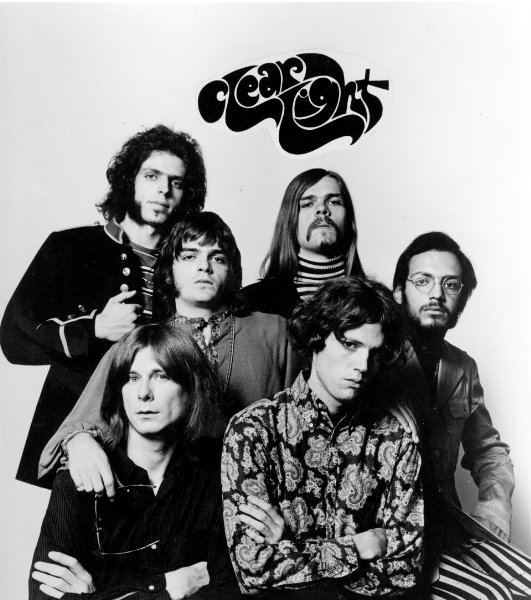
Clear Light was a psychedelic rock band that formed in Los Angeles in 1966. They were very much in the mold of fellow Elektra Records artists Love, Tim Buckley, and especially the Doors.
In 1966, the The Brain Train formed and was managed by Sunset Strip hipster Bud Mathis. They recorded a single at the time but soon changed their name to Clear Light where they were signed by Elektra. One condition was that they fire Bud Mathis and in doing so, Doors' producer Paul A. Rothchild took over management of the band.( I have included that single as a bonus)
The core members of the group were Bob Seal, lead guitarist and vocals, Robbie"The Werewolf" Robison, rhythm guitar and vocals, Doug Lubahn bass and vocals,Dallas Taylor drums, and Michael Ney, on, most unusually, another set of drums. They soon added Cliff De Young on lead vocals. This is the version of the band seen on their one and only album cover. However, sometime during the often described "brutal" recording process, Paul Rothchild was not happy with Robbie "The Werewolf" Robison's guitar playing skills and pressured the group to replace him. That is how keyboardist Ralph Schukett entered the band. For some reason, this was not properly addressed on the album cover and there vamped version of Clear Light appears only on the album insert, if you were lucky enough to get an original copy.
What has been considered the band's finest hour came when drunken customers in a Park Avenue club heckled them so brutally that Ralph Schuckett, the usually gentle organist, hurled a few choice words back at them. They then walked off fhe stage, retired to the Albert Hotel, and woke up in the morning to find that they had become underground heroes.
The big hit off their only album, Clear Light, was "Mr. Blue," a psychedelic version of a folk song written by Tom Paxton and a popular request on underground radio at the time, despite the fact it was never released as a single. Lasting over six minutes, the rather sinister, psychedelic song is considered a classic of the genre. Its lyrics, which alternate between spoken word and song, include verses opening with such lines as, "Good morning,Mister Blue, we've got our eye on you," "Step softly, Mister Blue, we know what's best for you," and "Be careful, Mister Blue, this phase you're going through ...."
The album also included some of guitarist Bob Seal's best psychedelic folk-rock songs, namely "With All in Mind" and "They Who Have Nothing." It had some success in England, but less in the U.S. The end of the group started when Paul Rothchild pressured the other members of the band to fire Bob Seal.When this happened, Cliff De Young was soon to follow and though they struggled on for a brief time, the band was essentially over, especially with the heart and spirit of the band, Bob Seal, gone. Seal was replaced by ex-Fug Danny "Kootch" Kortchmar but the group disbanded in 1968 after having started work on a second album.
Thee Sixpence was a garage rock/psych band that released a few singles in 1966-7 before recording "Incense And Peppermints", changing their name to Strawberry Alarm Clock, and achieving a fluke #1 hit. Most of the key musicians in the latter band were members at least part of the time in Thee Sixpence. Their short musical journey
Beginning with "Long Days Care" b/w "Can't Explain" in the summer of 1966, Thee Sixpence went on to release a total of ten songs in roughly as many months. The last two of these, "The Birdman Of Alkatrash" b/w "Incense And Pepermints", were re-released by Uni after the band had changed their name to Strawberry Alarm Clock; the a- and b-sides of the record were also reversed, reflecting the rapidly growing popularity of the original single's b-side. All of Thee Sixpence's 45s were released on the small All American label, though at least one, "Fortune Teller" b/w "My Flash On You", was also released on Dot.
Musically, Thee Sixpence was a rambunctious garage/punk band in the mold of the Leaves, the Standells, and early Love. In fact, the band recorded two of Arthur Lee's songs from Love's eponymous 1966 debut LP, "Can't Explain" and "My Flash On You". (Another Thee Sixpence recording, of "Hey Joe", may be seen as a de facto third Love cover.) The ten songs available by Thee Sixpence show obvious and remarkable progress over the band's short career; where their first single is exciting but just manages to hold things together, by the end Thee Sixpence was experimenting with daring arrangements, varied song structures, and much more assured playing.
Along the way, Thee Sixpence also released a real lost psychedelic classic, the haunting, horrifying "In The Building". Strawberry Alarm Clock themselves rarely exceeded the weirdness of this piece, and although the recording is somewhat crude in a late-66 kind of way, "In The Building" benefits from its earnest, untutored performance.
Thee Sixpence eventually added Mark Weitz on keyboards, and the Strawberry Alarm Clock sound proper was borne. The band brought in Randy Seol on drums, and along with long-time members Ed King, Lee Freeman, and Gary Lovetro, the Clock was set and worldwide fame, not to mention further audacious musical explorations, were continued right under the noses of listeners everywhere.
Bio from the SAC website Redid this post added new tracks and more color to posts
Tracks
Thee Sixpence.....
1 Long Days Care 2 Can't Explain 3 Fortune Teller 4 My Flash On You 5 In The Building 6 Hey Joe 7 Heart Full Of Rain 8 First Plane Home
Strawberry Alarm Clock
9 Incense And Peppermints 10 Birdman Of Alkatrash 11 The World On Fire
Bonus Tracks Very rare recording of SAC in Miami 1969
B1 Unknown Title B2 Miss Attraction B3 Drums>Incense And Pepperments
I will close this run on the LA bands with the group that I feel was the most influential on the music scene during the 60's. The Byrds crossed over to and from so many different kinds of music during their tenure. The original lineup helped begin giving the music fans their first look at electric-folk rock and psychedelic music. They were the front runners in the birth of country rock. In OMO they were the best in the LA scene.
The Byrds were an American rock band, formed in Los Angeles, California in 1964. The band underwent multiple line-up changes throughout its existence, with frontman Roger McGuinn (aka Jim McGuinn) remaining the sole consistent member until the group disbanded in 1973. Although they only managed to attain the huge commercial success of contemporaries like The Beatles, The Beach Boys, and The Rolling Stones for a short period of time (1965–66), The Byrds are today considered by critics to be one of the most influential bands of the 1960s. Initially, they pioneered the musical genre of folk rock, melding the influence of The Beatles and other British Invasion bands with contemporary and traditional folk music. As the 1960s progressed, the band was also influential in originating psychedelic rock, raga rock, and country rock. In addition, the band's signature blend of clear harmony singing and McGuinn's jangly twelve-string Rickenbacker guitar has continued to be influential on popular music up to the present day. Among the band's most enduring songs are their cover versions of Bob Dylan's "Mr. Tambourine Man" and Pete Seeger's "Turn! Turn! Turn! (to Everything There is a Season)", along with the self-penned originals, "I'll Feel a Whole Lot Better", "Eight Miles High", "So You Want to Be a Rock 'n' Roll Star", "Ballad of Easy Rider" and "Chestnut Mare".
The original five-piece line-up of The Byrds consisted of Jim McGuinn (lead guitar, vocals), Gene Clark (tambourine, vocals), David Crosby (rhythm guitar, vocals), Chris Hillman (bass guitar, vocals), and Michael Clarke (drums). However, this version of the band was relatively short-lived and by early 1966, Clark had left due to problems associated with anxiety and his increasing isolation within the group. The Byrds continued as a quartet until late 1967, when Crosby and Clarke also departed the band. McGuinn and Hillman decided to recruit new members, including country rock pioneer Gram Parsons, but by late 1968, Hillman and Parsons had also exited the band. McGuinn, who by this time had changed his name to Roger after a flirtation with the Subud religion, elected to rebuild the band's membership and between 1968 and 1973, he helmed a new incarnation of The Byrds, featuring guitarist Clarence White among others. McGuinn disbanded the then current line-up in early 1973, to make way for a reunion of the original quintet. The Byrds' final album was released in March 1973, with the reunited group disbanding soon afterwards.
Without a doubt The Doors were the most successful of the LA bands. They made music on their own terms Morrison wrote the poetry...Manzarek and Kreiger the fantastic music. It still lives vividly today....
The Doors was an American rock band formed in 1965 in Los Angeles, California, with vocalist Jim Morrison, keyboardist Ray Manzarek, drummer John Densmore, and guitarist Robby Krieger. The band took its name from Aldous Huxley's book The Doors of Perception,the title of which was a reference to a William Blake quotation: "If the doors of perception were cleansed every thing would appear to man as it is, infinite." They were among the most controversial rock acts of the 1960s, due mostly to Morrison's wild, poetic lyrics and charismatic but unpredictable stage persona. After Morrison's death in 1971, the remaining members continued as a trio until finally disbanding in 1973.
The origins of The Doors lie in a chance meeting between acquaintances and fellow UCLA film school alumni Jim Morrison and Ray Manzarek on Venice Beach in Los Angeles, California in July 1965. Morrison told Manzarek he had been writing songs (Morrison said "I was taking notes at a fantastic rock-n-roll concert going on in my head") and, with Manzarek's encouragement, sang "Moonlight Drive". Impressed by Morrison's lyrics, Manzarek suggested they form a band. Keyboardist Manzarek was in a band called Rick & the Ravens with his brothers Rick and Jim Manzarek, while drummer John Densmore was playing with The Psychedelic Rangers, and knew Manzarek from meditation classes. In August, Densmore joined the group and, along with members of The Ravens and bass player Pat Sullivan (later credited using her married name Patricia Hansen in the 1997 box CD release), recorded a six-song demo in September 1965. This has since then circulated widely as a bootleg recording. That month the group recruited guitarist Robby Krieger, and the final lineup — Morrison, Manzarek, Krieger and Densmore — was complete. The band took their name from a line in William Blake's poem The Marriage of Heaven and Hell; "If the doors of perception were cleansed everything would appear to man as it is, infinite".
By 1966, the group was playing the LA club London Fog and soon graduated to the prestigious Whisky a Go Go, where they were the house band, supporting acts including Van Morrison's group Them. On their last night together the two bands joined up for "In the Midnight Hour" and a twenty-minute jam session of Them's "Gloria". Prior to graduating to Whisky a Go Go Morrison went to many record labels trying to land a deal. He did score one but it did not pan out. On August 10, they were spotted by Elektra Records president Jac Holzman who was present at the recommendation of Love singer Arthur Lee, whose group was on Elektra. After Holzman and producer Paul A. Rothchild saw two sets of the band playing at the Whisky a Go Go, they signed them to the Elektra Records label on August 18—the start of a long and successful partnership with Rothchild and engineer Bruce Botnick. Later that month, the club fired the band after a profanity-filled performance of "The End". In an incident that foreshadowed the controversy that later followed the group, an acid-tripping Morrison raucously recited his own version of the Greek drama Oedipus Rex, in which Oedipus unknowingly kills his father and has sex with his mother.
A Ray Manzerak recollection of that particular night......
"In the most important rock club in Los Angeles, The Doors began to enjoy a celebrity audience from the recording industry and the attentions of several record companies. One evening, Miss Karan brought Jac Holzman, President of Elektra records, to hear the group. Holzman was unimpressed. However, he became more enthusiastic on a second visit. Urged on by Billy James, at that time Elektra's West Coast man, they signed The Doors in late 1966. The arrangement was, and still is, amiable on both sides, for The Doors, according to Manzarek, have been permitted freedom to work in the studio and Elektra has a top group that has enhanced its financial picture greatly. In January, 1967, their first album came out with a cut called "Light my fire". Before then, however, The Doors and the Whiskey had had a parting of the ways, mostly caused by "The End". "It started as a simple 'goodbye song', just the first verse and a chorus", says Morrison. "As we did it each night we discovered a peculiar feeling: a long, flowing, easy beat; that strange guitar tuning that sounds vaguely Eastern or American Indian. It was a form that everyone brought something to. Our last night at the Whiskey, I invented that climactic part about 'Father, I want to kill you....'. That's what the song had been leading up to." According to Manzarek, Morrison had missed the first set of the evening and the second set went without incident. The place was packed for the third set. Saturday night at the Whiskey with all the tourist and everything else. Jim sang 'The End' and the place was mesmerized by it. Then he did the 'Killer awoke before dawn' sequence. Everything just sort of stopped. It was really weird. When we finished, no one applauded or even talked. Mario (the Manager) just said, 'those guys are nuts- get them out of here,' and we were fired. No matter. By that time, The Doors were headed for the San Francisco ballrooms and a national tour".
The band recorded their first album from August 24 to 31, 1966 at Sunset Sound Recording Studios. 'The Doors' self-titled debut LP was released in the first week of January 1967. It featured most of the major songs from their set, including the nearly 12-minute musical drama "The End".
In November 1966, Mark Abramson directed a promotional film for the lead single "Break On Through (To the Other Side)". To promote the single, the Doors made their television debut on a Los Angeles TV show called Boss City, circa 1966, possibly early 1967 and then on a Los Angeles TV show called Shebang, miming to "Break On Through," on New Year's Day 1967. This clip has never been officially released by the Doors.
Since "Break on Through" was not very successful on the radio, the band turned to "Light My Fire". The problem with this song was that it was seven minutes long, so producer Paul Rothschild cut it down to a three minute song. The band's second single, "Light My Fire", became the first single from Elektra Records to reach number one on the Billboard Hot 100 singles chart, selling over a million copies. "Light My Fire" was the first song ever written by Robbie Krieger and was the beginning of the band's success.
Recorded live on their 1968 "Waiting for the sun" tour Soundboard recording
01 - Five To one 02 - Mack The Knife - Alabama Song 03 - Back Door Man 04 - You're Lost, Little Girl 05 - Love Me Two Times 06 - When The Music's Over 07 - Wild Child 08 - Money 09 - Wake Up 10 - Light My Fire 11 - The End 12 - Unknown Soldier
As with Spirit this band had 4 0r 5 very solid albums with a core line up before it began to frazzle out. I have done the same here and tried to give you a listen of Steppenwolf's many songs that are for many unheard. We all know "Born To Be Wild" but what about " Sparkle Eyes" Enjoy the tracks from the Wolf. Listening to this tight band makes one realize that even though it was mostly a John Kay vehicle the band members were extremely talented and important Listen to a couple of their instrumental tracks and you will see what I mean
Steppenwolf are a Canadian-American hard rock group that was prominent in the late 1960s. The group was formed in 1967 in Los Angeles by vocalist John Kay, guitarist Michael Monarch, bassist Rushton Moreve, keyboardist Goldy McJohn and drummer Jerry Edmonton after the dissolution of Toronto group The Sparrow of which Moreve was not a member.
The band has sold more than 25 million records worldwide,releasing eight gold albums and twelve Billboard Hot 100 singles of which six were Top 40 hits, including three Top 10 successes: "Born to Be Wild", "Magic Carpet Ride", and "Rock Me". Steppenwolf enjoyed worldwide success from 1968 to 1974, but clashing personalities led to the end of the core lineup
The name-change from The Sparrow to Steppenwolf was suggested to John Kay by Gabriel Mekler, being inspired by Hermann Hesse's novel of the same name.[3] Steppenwolf's first two singles were "A Girl I Knew" and "Sookie Sookie". The band finally rocketed to worldwide fame after their third single "Born to Be Wild" and their version of Hoyt Axton's "The Pusher" were prominently used in the 1969 cult film Easy Rider (both titles originally had been released on the band's debut album). In the movie, "The Pusher" accompanies a drug deal, and Peter Fonda stuffing dollar bills into his Stars & Stripes-clad fuel tank, after which "Born to Be Wild" is heard in the opening credits, with Fonda and Dennis Hopper riding their Indian and Harley choppers through the American West. The song, which has been closely associated with motorcycles ever since, introduced to rock lyrics the signature term "heavy metal" (though not about a kind of music, but about a motorcycle: "I like smoke and lightning, heavy metal thunder, racin' with the wind..."). Written by Dennis Edmonton, who had begun using the pen name Mars Bonfire, the song had already reached #2 on the Billboard Hot 100 in August 1968. It sold over one million copies, and was awarded a gold disc.
The following albums had several more hits, including "Magic Carpet Ride" (which reached #3) from Steppenwolf The Second and "Rock Me" (with its bridge lasting 1:06, which reached #10) from At Your Birthday Party. It also sold in excess of one million units.
Monster, which criticized US policy of the Nixon-era, and Steppenwolf 7 were the band's most political albums, which included the song "Snowblind Friend", another Axton-penned song, about the era and attitudes of drug problems.
There were several changes in the group's personnel after the first few years. Moreve was fired from the group in 1968 for missing gigs after he became afraid to return to Los Angeles, convinced that it was going to be leveled by an earthquake and fall into the sea. Rob Black filled in for Moreve until former fellow-Sparrow Nick St. Nicholas came aboard. Monarch quit after disagreements with Kay the next year year and was replaced by Larry Byrom, who'd been in TIME with St. Nicholas. St. Nicholas' tenure with the group proved to be brief and he was let go in 1970 after incurring Kay's wrath by showing up onstage in a bunny suit, and playing his bass loudly and out of tune. George Biondo was then recruited and guitarist Kent Henry replaced Byrom in 1971.The band broke up in 1972 following the release of another political concept album, For Ladies Only
From one of my personal favorite bands. Here is Spirit ( the original lineup). Probably the most underrated LA band from the late 60's. They continued to perform under different member lineups until Randy California's untimely death from drowning. I have put together a Spirit comp that takes a look at their early top notch releases focusing on the songs you do not here every day. We all know "Nature's Way" or" I Got A Line On You" but you do not hear "Taurus" or "Topanga Windows" so often. I remember them playing in St. Louis and the local radio station KSHE was using this slogan for the advertisement......."All That Is....Spirit" and that rings so true even today ( at least for me)
Spirit was an American jazz/hard rock/progressive rock/psychedelic band founded in 1967, based in Los Angeles, California.
The original lineup of the group evolved from an earlier Los Angeles band, The Red Roosters, which included Randy California (guitars, vocals), Mark Andes (bass) and Jay Ferguson (vocals, percussion). With the addition of California's stepfather Ed Cassidy (drums), and keyboard player John Locke the new band was originally named the Spirits Rebellious (after a book by Khalil Gibran) but was soon shortened simply to Spirit. Randy California had also played with Jimi Hendrix (then known as Jimmy James) in Jimmy James and the Blue Flames in 1966.
Cassidy was instantly recognizable by his shaven head (hence his nickname "Mr. Skin") and his fondness for wearing black. He was around twenty years older than the rest of the group (born in 1923). His earlier career was primarily in jazz and included stints with Cannonball Adderley, Gerry Mulligan, Roland Kirk, Thelonious Monk and Lee Konitz. He was a founding member of Rising Sons with Taj Mahal and Ry Cooder.
The group's first album, Spirit, was released in 1968. "Mechanical World" was released as a single (it lists the playing time merely as "very long"). The album was a hit, reaching #31 on The Billboard 200 and staying on the charts for over eight months. The album displayed jazz influences, as well as using elaborate string arrangements (not found on their subsequent recordings) and is the most overtly psychedelic of their albums.
They capitalized on the success of their first album with another single, "I Got A Line On You". Released in November 1968, a month before their second album, The Family That Plays Together, it became their biggest hit single, reaching #25 on the charts (#28 in Canada). The album matched its success, reaching #22. They also went on tour that year with support band Led Zeppelin, who were heavily influenced by Spirit—Led Zeppelin played an extended medley during their early 1969 shows that featured "Fresh Garbage" among other songs, Jimmy Page's use of a theremin has been attributed to his seeing Randy California use one that he had mounted to his amplifier, and it is now widely accepted that Page lifted the descending guitar figure from Spirit's instrumental "Taurus" for Led Zeppelin's signature tune "Stairway To Heaven".
After this success, the group was asked by French film director Jacques Demy to record the soundtrack to his film, Model Shop and they also made a brief appearance in the film[citation needed]. Their third album, Clear, released in 1969, reached #55 on the charts. Spirit were offered the spot right before Jimi Hendrix at Woodstock, but they were advised to turn it down and concentrate on a promotional tour for their third album. Record company managers felt that the festival would not be significant[citation needed], as it did not seem so at that time, and so they missed out on the massive international exposure that the festival and the subsequent film documentary generated.
After the release of Clear, California was called upon again to give the group a hit single. With the group producing the record on their own, they recorded a song California had written called "1984". It looked at first as though it would be the group's biggest hit yet. Soon after being released, it placed at #69 on the Billboard charts.
In retrospect, no one is sure why the single had such a brief chart life, but there are several possibilities. It is no secret that Lou Adler's alliance with Epic Records was uneasy at best, and at the time that the single was released, Adler's distribution deal with Epic came to an end. He had been eager to move distribution of the label to A&M Records, which he did as soon as the deal with Epic ended, which might have killed the commercial availability of the single (though Adler ended up giving Spirit's contract to Epic in the process). It has also been said that there was a tip sheet distributed to radio stations outlining the song's supposed political and social views, and opining that it might not be appropriate for air play. The song would finally see general release on The Best of Spirit in 1973.
In 1970, Spirit started working on what is widely considered to be their best LP, Twelve Dreams of Dr. Sardonicus. On the recommendation of Neil Young the band chose David Briggs as the producer. It was a prolific time for the group's writers and the album was finally released in late 1970. Especially memorable was Randy California's poignant "Nature's Way," which was written in an afternoon when the group was playing at the Fillmore West in San Francisco.
Epic released an early mix of "Animal Zoo" as a single, but this only made it to #97 on the charts. Like The Who's Tommy and Pink Floyd's The Dark Side of the Moon, Twelve Dreams of Dr. Sardonicus is critically regarded as a landmark of art rock, with a tapestry of literary themes about the fragility of life and the complexity of the human experience, illustrated by recurring lyric "life has just begun", and continued the group's pioneering exploration of environmental issues in their lyrics (cf. "Fresh Garbage"). The album is also notable for its inventive production and the use of a modular Moog synthesizer.
Canned Heat was started as a jug band in November 1965, in Northridge, California by a group of "musicologists" who loved blues music. Soon the band evolved into an electrified blues/rock band with the uncanny ability to interpret and create a modern version of the blues. While they never reached the popular acclaim of some of the other bands of the psychedelic era, none the less, they were a talented group of musicians who created some of the most unique music of that or any rock and roll era. Musical trends come and go. Canned Heat's "boogie music" has been at the forefront of popularizing blues music, as exemplified by such hits as "On The Road Again", "Goin' Up The Country", "Let's Work Together", "Amphetamine Annie" and "Refried Boogie.
The primary members of Canned Heat include such legendary musicians as singer and 300-pound, former record-store manager Bob "The Bear" Hite who grew up in Denver. The Bear once said that "to sing the blues, you have to be an outlaw. Blacks are born outlaws, but we white people have to work for that distinction." The Bear died on April 6th, 1981 of a drug-related heart seizure behind the Palomino Club in North Hollywood, California.
Rhythm/slide guitarist and harmonica player Alan "Blind Owl" Wilson, born in 1943, grew up in Arlington, Ma. When the band formed he was a musicology student. He was an avid record collector and a firm believer in true roots music. Wilson died from depression mixed with a heroin drug overdose in September 1970 at 27. Joel Scott Hill was brought in to sing for Wilson. On Hooker 'n Heat, a framed photograph of the "Blind Owl" is on the wall above the band in memoriam.
Born Christmas Day, 1944, lead guitar player Henry "The Sunflower" Vestine was a former member Frank Zappa's Mother's of Invention. Vestine eventually left Canned Heat to form a new band and was replaced by Detroit's Harvey Mandel. Vestine died on Oct. 20, 1997 from heart and respiratory failure in a hotel outside Paris. His ashes, now buried at Oak Hill Cemetery, will eventually be transported to a crater on the dark side of the Moon named after his father, a noted astrophysicist.
Original drummer Frank Cook was replaced by Adolfo "Fito" de la Parra, when the band felt that it needed a more R&B type rhythm for their second album. Original bassist Stuart Brotman was replaced by Larry "The Mole" Taylor who eventually left for Mayall and subsequently was replaced by Mark Andes of Spirit. Other members through the years include Harvey "The Snake" Mandel, Junior Watson and Robert Lucas. They can boast of collaborations with Little Richard, John Mayall, and John Lee Hooker.
Their debut album was released on the Liberty label in 1967 just in time to make a major appearance at the Monterey Pop Festival. After being arrested in Denver on drug charges the band's image as the bad boys of rock eventually led to their becoming a favorite of the Hells Angels and other biker clubs. For their second album, Wilson wrote "On The Road Again," which featured Wilson's high-pitched vocals. In 1968, the band released their next effort, a two record set "Living the Blues", that featured "Going Up The Country" which was to many a highpoint of the legendary Woodstock festival. Wilbert "Kansas City" Harrison's "Let's Work Together," pumped up the charts about the same time Caned Heat was gigged at the Isle of Wight festival. Canned Heat continues today with long time members Fito de la Parra and Larry "the Mole" Taylor leading the way. Vocal duties have been handled over the years by Walter Trout, James Thornberry and Robert Lucas. Recently, Fito de la Parra has written a book, "Living the Blues," which chronicles the history of Canned Heat. CANNED HEAT FILLMORE WEST,S.F. JULY,1969
Line up: Bob " the Bear" Hite:voc.,harp Alan Wilson:voc.,guit., harp Larry Taylor:bass Fito de la Parra: drums Harvey Mandel: guit.
Setlist: 1 Oh Baby 2 My Time Ain´t Long 3 Sugar Mama 4 Shake it & Break it 5 I´m Her Man 6 Rock Me Baby 7 Future Blues 8 A Change Is Gonna Come
Robert Markley was a bizarre and eccentric musician of the 1960s who formed the West Coast Pop Art Experimental Band in Los Angeles in 1966 with guitarists Shaun Harris and Dan Harris, and help from Kim Fowley. Following a collection of covers titled Volume One (Fifo, 1966), the psychedelic music of their second album, Part One (Reprise, 1967 ), fragile and dreamy, had little in common with the bands of their era (Shifting Sands). The third album would be released only 24 years later, as The Legendary Unreleased Album (Raspberry, 1980).
The following album Breaking Through Volume 2 (Reprise, 1967) was less successful in recreating that surreal atmosphere, despite the lengthy Smell Of Incense and the Fugs-ian satire of Suppose They Give Us A War And Nobody Comes. The first two official album are summarized on Transparent Day (Edsel, 1986).
The band released A Child's Guide To Good & Evil (Reprise, 1968), which increased the similarities with the Fugs, both in terms of agit-prop satire (Until The Poorest People Have Money To Spend, A Child Of A Few Hours Is Burning To Death) and in terms of bizarre collage techniques (Anniversary Of World War 3, with proto-glitch music), Where's My Daddy (Amos, 1969) and Markley A Group before disappearing.
Kaleidoscope was an American psychedelic folk and ethnic band who recorded 4 albums and several singles for Epic Records between 1966 and 1970. They formed in and around the Topanga Canyon area of Los Angeles.
The group was formed in 1966. The original members were:
David Lindley Solomon Feldthouse Chris Darrow Chester Crill John Vidican
Lindley was an experienced performer on a variety of stringed instruments, notably the banjo, winning the Topanga Canyon Banjo Contest several years in a row. While studying at La Salle High School in Pasadena, he formed his first group, the Mad Mountain Ramblers, who performed around the Los Angeles folk clubs. There, he met Darrow, who was a member of a rival group, the Re-Organized Dry City Players. Soon afterwards, around 1964, the pair formed a new group, the Dry City Scat Band, which also included fiddle player Richard Greene (later of Seatrain), but Darrow soon left to set up a new rock group, The Floggs. Lindley also began forming his own electric group. In the course of this he met Feldthouse, who had been raised in Turkey and, on returning to the US, had performed flamenco music and as an accompanist to belly dancing groups. Lindley and Feldthouse then began performing as a duo, David and Solomon, when they met Chester Crill. They invited him to join their band, and by the end of 1966 added Darrow and drummer John Vidican, so forming The Kaleidoscope.
The group was founded on democratic principles – there was no "leader". They soon began performing live in clubs, winning a recording contract with Epic Records. The first single, "Please", was released in December 1966. It was produced by Barry Friedman (later known as Frazier Mohawk), as was their first album Side Trips, released in June 1967. The album showcased the group’s musical diversity and studio experimentation. It included Feldthouse's "Egyptian Gardens", Darrow’s "Keep Your Mind Open", and versions of Cab Calloway's "Minnie the Moocher" and Dock Boggs' "Oh Death". Crill, for reasons he never made clear (but ex-bandmates speculated had to do with concerns over reactions from his "straightlaced" parents), was credited as "Fenrus Epp" on the first album and adopted various other pseudonyms on later recordings.
Between them, the group played a huge collection of stringed instruments in such early psychedelic songs as "Egyptian Gardens" and "Pulsating Dream." They played fusions of Middle-Eastern music with rock in longer pieces such as "Taxim," which they performed live at the Berkeley Folk Festival on July 4, 1967. Live, band numbers were sometimes interspersed by solo instrumental turns from Feldthouse or Lindley, and occasionally Feldthouse brought belly dancers or flamenco dancers on stage.They were such adept musicians that they could play in many different styles, including rock, blues, folk, jazz, Middle-Eastern and also were not afraid to feature music by Calloway and Duke Ellington in their repertoire. Kaleidoscope were one of the progenitors of World Music.
Their 1967 piece "Stranger in Your City"/"Beacon from Mars," recorded live in the studio, was also influential, with Led Zeppelin's Jimmy Page calling them his "favourite band of all time." It featured a solo by Lindley in which, on stage, he used a violin bow on electric guitar, probably inspiring Page to use the same effect later. Another influential guitarist, Eddie Phillips of UK psych group 'Creation', was using a violin bow on a guitar as early as 1966. The album A Beacon from Mars was released in early 1968, to generally good reviews but poor sales. Liner notes to the CD reissue of this album claim the original title was "Bacon From Mars" but it was misprinted.
The band recorded their third album, Incredible! Kaleidoscope, in 1968. It featured "Seven-Ate Sweet", a long progressive instrumental piece in 7/8 time signature which they had been playing live since the early days of the group. The album reached #139 on Billboard in 1969, the only Kaleidoscope album to chart. Around this time they also did soundtrack work on educational and other films, and also made a triumphant appearance at the Newport Folk Festival.
Kaleidoscope’s fourth and final album (as a band), Bernice, featured more electric guitar work than the earlier albums, and more country influence. There were further personnel changes, adding singer-guitarist Jeff Kaplan, and bassist Ron Johnston who replaced Brotman during the making of the album. Feldthouse also left the group.
At the end of 1969, Kaleidoscope contributed two new songs ("Brother Mary" and "Mickey's Tune") to Michelangelo Antonioni's Zabriskie Point, and supported Cream on their American farewell tour. The band split up soon afterwards.
KALEIDOSCOPE live 1967/68 Audience Tapes - Sound is good for it's age
1 Oh Death 2 Taxim 3 Egyptian Gardens
(Berkeley Folk Festival 07-04-1967)
5 The Cuckoo 6 Maggie Mae 7 Hello Trouble 8 An Eastern Lullaby to Christopher Dee 9 Killing Floor
(Live at Shrine Hall; LA 08-04-1968)
10 Minnie the Moocher 11 Steppin' Out 12 Beacon from Mars 13 Boogaloo Down Broadway (David Lindley solo) 14 Taxim 15 (cuts in) Flamenco guitar/vocal (Solomon Feldthouse solo) 16 Steppin' Out 17 Seven-Ate Sweet
(Club 47 Cambridge, MA, US) Probable date: December 1967
Psychedelic rock band formed in Los Angeles, 1966. Spun off from the folk-rock band Ashes, incl. John Merrill (guitar/ vocals), Alan Brackett (bass/ vocals), Barbara Robison (vocals), Spencer Dryden (drums) and Jim Cherniss (guitar/ vocals). Ashes recorded a 45 for Vault Records mid-1966, after which Dryden split to San Francisco to replace Skip Spence in Jefferson Airplane. Around this time Robison had given birth to a son (Scott) and Merrill had left for Europe, while Cherniss also parted ways with the group. Brackett then hooked up with a new guitarist named Lance Fent and a new drummer, Jim Voigt.
According to Alan Brackett: "I got together upon John's recommendation with Lance Fent and Jim Voigt and, with the help of Owsley, we learned 50 or so songs in one day and went out that night and got our choice of about three gigs in Hollywood. We played at the Sea Witch on Sunset Blvd. as the Crossing Guards. We were a power trio, and then John and Barbara joined back up with us and we changed our name to the PBC. The PBC was a name that Jim Voigt came up with-- actually it was the Peanut Butter Controversy originally, but we changed it to Conspiracy right away."
Their first release under their new moniker was the late-1966 gem "Time Is After You", a song they later re-visited on THE GREAT CONSPIRACY. Their new manager Billy James had already succeeded in getting the Rising Sons their deal with Columbia, and he made sure the PBC signed up with CBS after a bidding war ensued with Elektra. The debut 45 for the new label was the timely "It's a Happening Thing", produced by west coast studio impresario Gary Usher. The single cracked the KHJ "Boss 30" in February of 1967 and eventually became a regional hit, charting at #93 nationally. The follow-up single "Then Came Love" featured a magnificient lead vocal from Barbara Robison (or "Sandi Peanut Butter" as she was called at that time), but it failed to chart. However, the song is still notable for being one of the earliest (and best) attempts at symphonic rock music, predating the Beatles' SGT PEPPER'S LONELY HEARTS CLUB BAND.
The new band's debut LP, THE PEANUT BUTTER CONSPIRACY IS SPREADING, was also recorded with Gary Usher at the helm. During the sessions Gary called upon musicians such as Glen Campbell and James Burton to help bolster the sound, and the group later disavowed the record for that reason. Nevertheless, it stands as a fine relic from the early Flower Power era with strong original compositions by Merrill and Brackett, particularly the memorable "Most Up 'til Now" and the cautionary "Why Did I Get So High?" The album scraped the lower reaches of the Billboard Top 200, largely based on word-of-mouth surrounding the band's live shows. In the studio the Peanut Butter Conspiracy crafted intricate melodies with adventurous progressions that were by turns dark and optimistic. Their blend of male and female voices reminded many of the Mamas and Papas. They were at their best when they let Sandi Peanut Butter take center stage, conjuringing up dreamy psychedelic riffs around her soulful vocals. (Sandi could sound like Cher one minute and Cass Elliot the next; a very commercial sound for an underground band, but it worked.)
Apart from the Byrds, no other American band had as great an impact on folk-rock and country-rock -- really, the entire Californian rock sound -- than Buffalo Springfield. The group's formation is the stuff of legend: driving on Sunset Boulevard in Los Angeles, Stephen Stills and Richie Furay spotted a hearse that Stills was sure belonged to Neil Young, a Canadian he had crossed paths with earlier. Indeed it was, and with the addition of fellow hearse passenger and Canadian Bruce Palmer on bass and ex-Dillard Dewey Martin on drums, the cluster of ex-folkys determined, as the Byrds had just done, to become a rock & roll band.
Buffalo Springfield wasn't together long -- they were an active outfit for just over two years, between 1967 and 1968 --but every one of their three albums was noteworthy. Their debut, including their sole big hit (Stills' "For What It's Worth"), established them as the best folk-rock band in the land barring the Byrds, though Springfield was a bit more folk and country oriented. Again, their second album found the group expanding their folk-rock base into tough hard rock and psychedelic orchestration, resulting in their best record. The group was blessed with three idiosyncratic, talented songwriters in Stills, Young, and Furay (the last of whom didn't begin writing until the second LP) yet they also had strong and often conflicting egos, particularly Stills and Young. The group, who held almost infinite promise, rearranged their lineup several times, Young leaving the group for periods and Palmer fighting deportation, until disbanding in 1968. Their final album clearly shows the group fragmenting into solo directions.
Eventually, the inter-personal tensions and creative battles led to a perhaps inevitable split, starting with Young's departure for a solo career. He would later reunite with Stephen Stills in Crosby, Stills, & Nash, joining the trio once a decade for various projects. In addition to CSN, Stills released solo albums and worked with a nother band, Manassas. Initially, Jim Messina and Richie Furay stayed together, forming the country-rock group Poco, but Messina left after three albums to team up in a duo with Kenny Loggins. Furay himself left Poco and teamed with Chris Hillman and JD Souther in the Souther Hillman Furay Band before pursuing a solo career. Richie Unterberger
BUFFALO SPRINGFIELD Huntington Beach 1967 [no label, 1CD] Live at The Teen And Twenty Club, Huntington Beach, CA; August 11, 1967. Very good audience recording.
Lineup: Stephen Stills - guitar, vocal Richie Furay - guitar, vocal Doug Hastings - guitar Bruce Palmer - bass Dewey Martin - drums, vocal
A very interesting recording of the band while Young is off on one of his frequent decisions to leave the group . The band brings in Doug Hastings from the Daily Flash and he stays with the group for a couple of months. He plays Monterey with them and fills in for the on and off Young. And for guitarist Doug Hastings, the Huntington show ended on a bittersweet note.
“It came completely out of the blue,” claims Doug (Hastings). “I got the call in late afternoon (August 12, 1967) and we had a gig that night. Stephen called me up and the conversation went something like, ‘Well old buddy, Neil’s (N Young) gonna be back in the band. Things just didn’t work out so good luck in your future and we’ll be seeing ya.’ Click. That was pretty much it. I felt like shit. I was disappointed but I never felt that secure in the group, that I was a solid member. One day I was in and two months later I was gone.”
LOVE...An American psychedelic rock group formed in Los Angeles in 1965. They were led by singer, songwriter and guitarist Arthur Lee (March 7, 1945 - August 3, 2006) and the group's second songwriter, guitarist Bryan Maclean (September 25, 1946 - December 25, 1998). One of the first racially diverse American pop bands, their music reflected a remarkable array of influences, combining elements of rock and roll, garage rock, folk, showtunes and psychedelia. Other members included John Echols, Johnny Fleckenstein, Don Conka, Alban Snoopy Pfisterer, Ken Forssi, Tjay Cantrelli, Michael Stuart, Jay Donnellan, Gary Rowles, Frank Fayad, and George Suranovich.
Love grew out of the Los Angeles garage band The Grass Roots, changing their name in 1965 to avoid confusion with the P.F. Sloan-managed band of the same name. The band lived communally in Bela Lugosi's former LA residence The Castle, and the house forms the background to the cover of their first two album sleeves.
Love started playing the Los Angeles clubs in April 1965 and became a popular act. At this time, they were playing extended numbers such as "Revelation" (originally titled "John Lee Hooker") and getting the attention of such contemporaries as the Rolling Stones and the Yardbirds.
Love released their eponymous début album in July 1966. This was followed later the same month by the single "Seven and Seven Is/No. Fourteen", neither side of which was included on the album, and which gave the band their only U.S. Billboard top 40 hit.
Love's second album Da Capo was released in January 1967. The album is split between a more conventional first side, featuring 6 tracks (including Seven And Seven Is) and a second side featuring just one near twenty-minute track, Revelation.
The band's critical reputation far exceeds the limited success they experienced: their second album to be released in 1967, Forever Changes, is consistently cited by critics as one of the most outstanding albums in the history of rock music. The album features full and complex orchestration throughout, accompanying Lee and MacLean's increasingly elaborate song writing. The album sold poorly in the U.S., reaching #154 on the Billboard charts, although it performed better in some European territories.
Although the band continued to record after Forever Changes, subsequent releases saw frequent large-scale personnel changes, and a move away from the more baroque style of that album towards traditional rock and latterly to soul and funk.
This is a repost from awhile back but it seemed to fit here in this LA special. This a reunion show from 1989 that featured all three of these acts. In thinking about this one I wanted to bring forth some words about these bands and there influential front men. We looked at Sky saxon and the Seeds on the last post. Sky went on from the Seeds to become somewhat of a cult hero for years up until his passing. The Seeds should be remembered as on one of LA's most significant bands with their unique sound and the birth of the flower power explosion. Many bands would follow in that vein but the Seeds were the best.
Sean Bonniwell is the leader of the Music Machine. I do believe that he still plays today with that band moniker. The Music Machine had a sound of their own with it's heavy bass lines and deep thundering sound. The visual impression of the band was also totally different. The dressed in black, wore a single black glove on one of their hands and had very Beatle like haircuts. The glove thing came long before the so called king of pop used it. They made only two LP's Both were very similar in sound and Bonniwell went on to release a solo project
Arthur Lee and Love rank as one of the most prominent bands to play the LA strip scene in 65-66. They played the Whisky and caught the attention of Elecktra records before the Doors. The band actually had two front-men in Arthur and Bryan MacClean but Arthur's demanding attitude made his the real driving force behind LOVE. After two hard rocking LP's The band would put together the unforgettable " Forever Changes" LP There is speculation has to who actually played on this masterpiece but I know that each original band member made significant contributions with Athur being once again the domineering . Interesting to note is that Bryan's composition " Alone Again Or" is the most celebrated song on the LP.
THE MUSIC MACHINE.............. THE SEEDS................ LOVE
27 January, 1989 Universal Ampitheatre Los Angeles, California, USA
01 Talk Talk (Music Machine) 02 The People In Me (Music Machine) 03 Masculine Intuition (Music Machine) 04 C.C. Rider (Music Machine) 05 Trouble (Music Machine) 06 Mother Nature Father Earth (Music Machine) 07 Double Yellow Line (Music Machine) 08 Evil Hoodoo (Seeds) 09 Mr. Farmer (Seeds) 10 Try to Understand (Seeds) 11 Can't Seem to Make You Mine (Seeds) 12 Pushin' Too Hard (Seeds) 13 Give Peace a Chance (Seeds) 14 Alone Again Or (Love) 15 Signed D.C. (Love) 16 My Little Red Book (Love) 17 Orange Skies (Love) 18 Seven and Seven Is (Love) 19 And More Again (Love) 20 Everybody's Got to Live (Love)


.jpg)